
Mandated Taxpayer
Large Taxpayers
Prepare transaction systems, document scope, integration requirements, and assigned EIS owners.

Understand your EIS requirements, system integration, certification, testing, and transmission requirements well ahead of the deadline.
EIS was mandated under the TRAIN Law (Republic Act No. 10963) as part of the Philippines’ shift toward digital tax administration. It enables eligible taxpayers to issue electronic invoices or receipts and transmit sales data directly to the BIR, replacing or supplementing traditional paper-based processes.
The practical work is cross-functional: leadership, finance, accounting, IT, and compliance all play a role in preparing systems and operations.
Mandated Taxpayer
Prepare transaction systems, document scope, integration requirements, and assigned EIS owners.
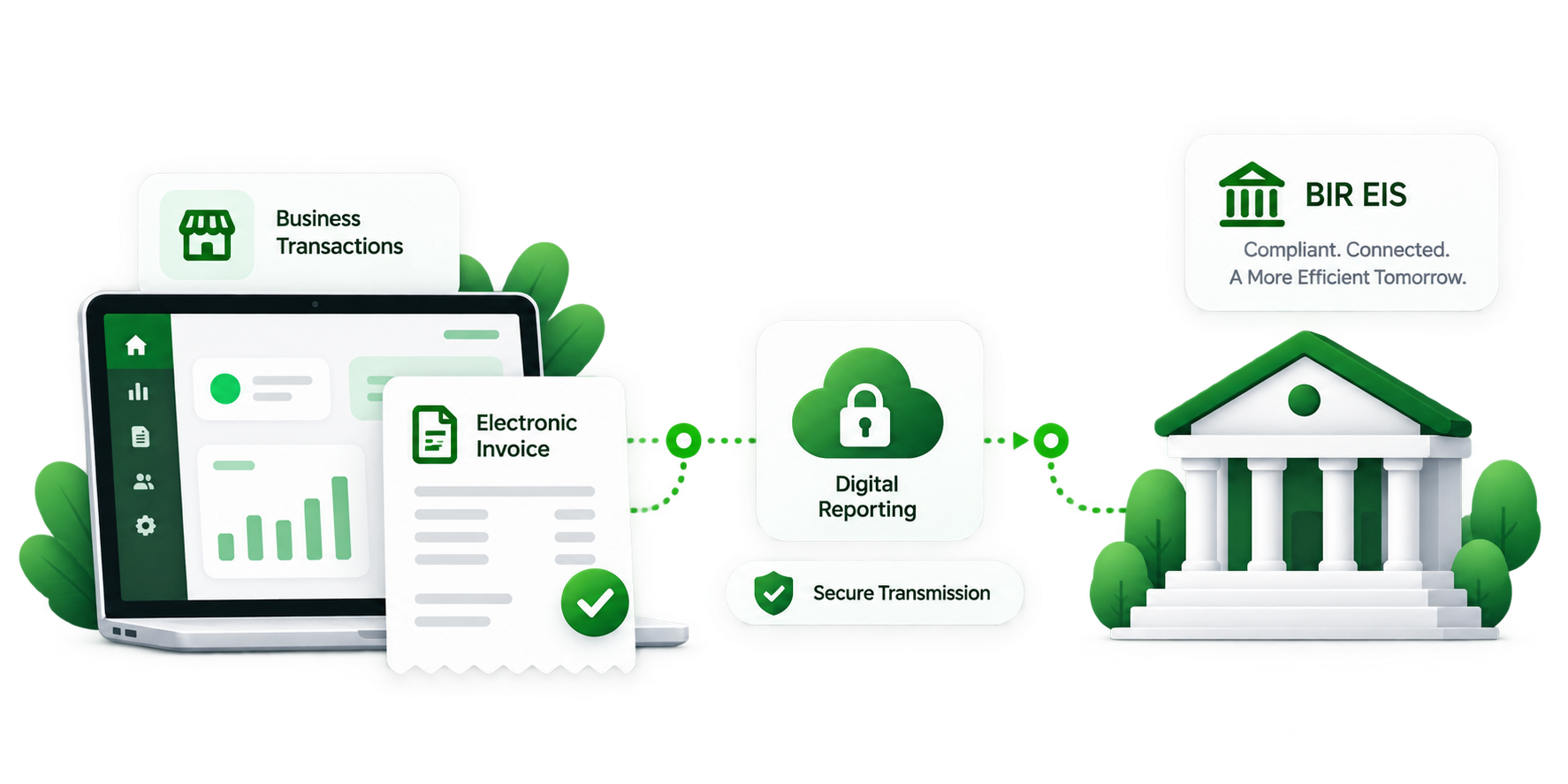
Mandated Taxpayer
Assess how sales and billing data can be transformed into compliant electronic reporting workflows.

Mandated Taxpayer
Connect digitally generated transactions with the required invoice, sales-data, and transmission processes.
The BIR has extended the transition period to December 31, 2026 — early adoption gives your organization more time to resolve process and integration gaps before that deadline and stricter enforcement.
Choose whether your operating model is better suited to real-time or near real-time submission.
Identify the Persons In Charge (PICs) for certification, sandbox testing, Taxpayer Portal activity, and go-live monitoring.
The 7-step certification testing process is identified as the most time-consuming stage in the onboarding journey.
Each portal serves a distinct role in issuing, certifying, or administering electronic invoicing and sales reporting.
Used to issue e-receipts and e-invoices as a standalone facility or together with an existing system, with inquiry, statistics, customer and item listing functions.
Used to certify middleware that connects POS/CRM, CAS, or ASP systems to BIR and to support the application for a Permit to Transmit.
Used internally by BIR revenue officers — taxpayers don't access this portal directly.
Register the organization and begin developing or configuring the middleware that will connect your systems to BIR.
Complete the BIR-provided sandbox process, including transmission and compliance testing.
After successful certification, apply for formal permission to transmit live sales data.
Begin operational sales-data transmission to BIR under the approved permit.
Instead of treating EIS as another isolated compliance project, Direc helps teams understand their current environment first — systems, data sources, transmission needs, ownership, and testing requirements.
Readiness Snapshot
Current EIS Readiness